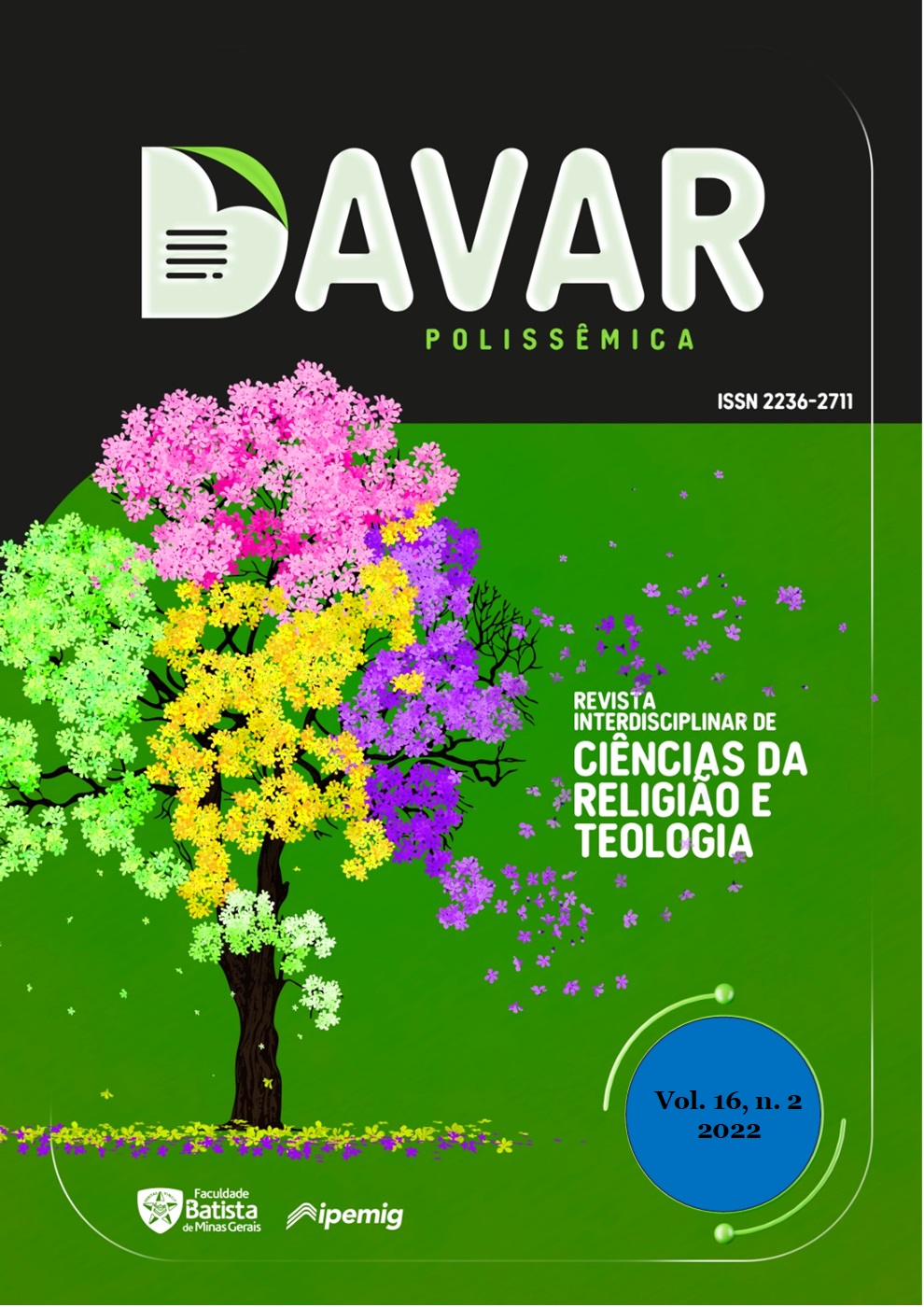
La masculinidad contracultural de Jesús para una hermenéutica y pastoral del Espíritu
Keywords:
Masculinidades, Bíblia, Pentecostalismo, Jesus, Espírito SantoAbstract
O texto oferece uma reflexão sobre a necessidade de desconstrução da masculinidade cristã históricamente sedimentada à luz da masculinidade de Jesus, como um desafio a partir do diálogo intercultural para uma hermenêutica e pastoral do Espírito. A pesquisa percorre elementos-chave, como o cenário cultural que envolveu as concepções de masculino e feminino nos tempos bíblicos, especialmente a mensagem de Jesus nos textos do Novo Testamento. Além disso, enfatiza a recuperação de elementos da masculinidade jesuânica à luz do Espírito.
References
AZCUY, Virginia R. El lugar teológico de las mujeres. Revista Proyecto, v. 39, p. 11-34, 2001.
AZCUY, Virginia. Otra masculinidad es posible. Revista Vida Nueva. 21 abr. 2020. Disponible en: https://www.vidanuevadigital.com/tribuna/otra-masculinidad-es-posible/
CÁCERES, Hugo. Jesús, el varón. Aproximación bíblica a su masculinidad. Navarra: Verbo Divino, 2011.
CÁCERES, La masculinidad de Jesús como proyecto liberador. Recurso disponible en: https://www.vidadelacer.org/images/documentos/caceres.pdf
CAMPOS, Bernardo. Hermenéutica del Espíritu. Cómo interpretar los sucesos del Espíritu a la luz de la palabra de Dios. Bassel Publishers-Instituto Elías, 2016.
COMBLIN, José. El Espíritu Santo y la Liberación. São Paulo: Paulinas, 1987.
CONTI, Cristina. En el oikos patriarcal, cada uno en su lugar. RIBLA, v. 68, p. 89-99, 2011.
COTHENET, Edouard. Las cartas a los colosenses y a los efesios. España: Verbo Divino, 1994.
DEBERGÉ, Pierre. Pablo, el pastor. Navarra: Verbo Divino, 2005.
ESTÉVEZ, Elisa. Qué se sabe de las mujeres en los orígenes del cristianismo. España: EVD, 2012.
FOULKES, Irene. Los códigos de deberes domésticos en Colosenses 3,18-4,1 y Efesios 5,22-6,9 –Estrategias persuasivas, reacciones provocadas. RIBLA, v. 55, p. 52-80, 2006.
KEENER, Craig S. Comentario del Contexto Cultural de la Biblia NT. EEUU: Mundo Hispano, 2003.
LÓPEZ, Darío. La masculinidad de Jesús. In: PUBLICA Theology in Public Life [sitio web]. 2 may. 2021. Recurso disponible en https://publicatheology.org/2021/05/02/la-masculidad-de-jesusimg-new/
MALDONADO, Jorge E. Fundamentos bíblico-teológicos del matrimonio y la familia. EEUU: Libros Desafío, 2006.
MORA PAZ, César. Carta a los Colosenses. In: LEVORATTI, Armando. Comentario Bíblico Latinoamericano. Navarra: Verbo Divino, 2007.
MORACHO, Félix. Lo que Jesús hacía y decía. Colombia: San Pablo, 1996.
OSIEK, Carolyn et al. El lugar de la mujer en la Iglesia Primitiva. Salamanca: Sígueme, 2007.
ROPERO, Alfonso. Gran Diccionario Enciclopédico de la Biblia. España: Clie, 2013.
STAAB, Karl. Cartas tesalonicenses cautividad y pastorales. Barcelona: Herder, 1974.
TAMEZ, Elsa. Visibilidad, exclusión y control de las mujeres en la primera carta a Timoteo. RIBLA, v. 55, p. 35-40, 2006.
TAMEZ, Elza. Las mujeres en el movimiento de Jesús. Lecturas bíblicas en Perspectiva Feminista. Florida: Juanuno1, 2020.
THURMAN, Eric. Looking for a Few Good Men: Mark and Masculinity. New Testament Masculinities, p. 137-161, 2003.
Downloads
Published
How to Cite
Issue
Section
License
Copyright (c) 2024 Davar Polissêmica

This work is licensed under a Creative Commons Attribution-NonCommercial 4.0 International License.
I (we) submit this original and unpublished work, authored by me (us), for review by the journal Davar Polissêmica, an interdisciplinary journal of Religious Studies, Theology, and related fields, based at IPEMIG College, and I (we) agree to share the copyrights pertaining to this work with DAVAR and that its “content, or part thereof, may be copied, distributed, edited, remixed, and used to create other works, always within the limits of copyright and related rights legislation,” in any medium, whether print or electronic, provided that credit is given to the text and its authorship, including references to DAVAR. I (we) further declare that there is no conflict of interest between the topic addressed, the author(s), and any companies, institutions, or individuals.
I (We) further acknowledge that DAVAR is licensed under a CREATIVE COMMONS ATTRIBUTION 4.0 (CC BY 4.0) LICENSE: This work is licensed under a Creative Commons Attribution 4.0 International License.
Therefore, I (WE) PERMIT, “to maximize the dissemination of information,” that others distribute, remix, adapt, and build upon this work, provided they give proper credit for the original creation.